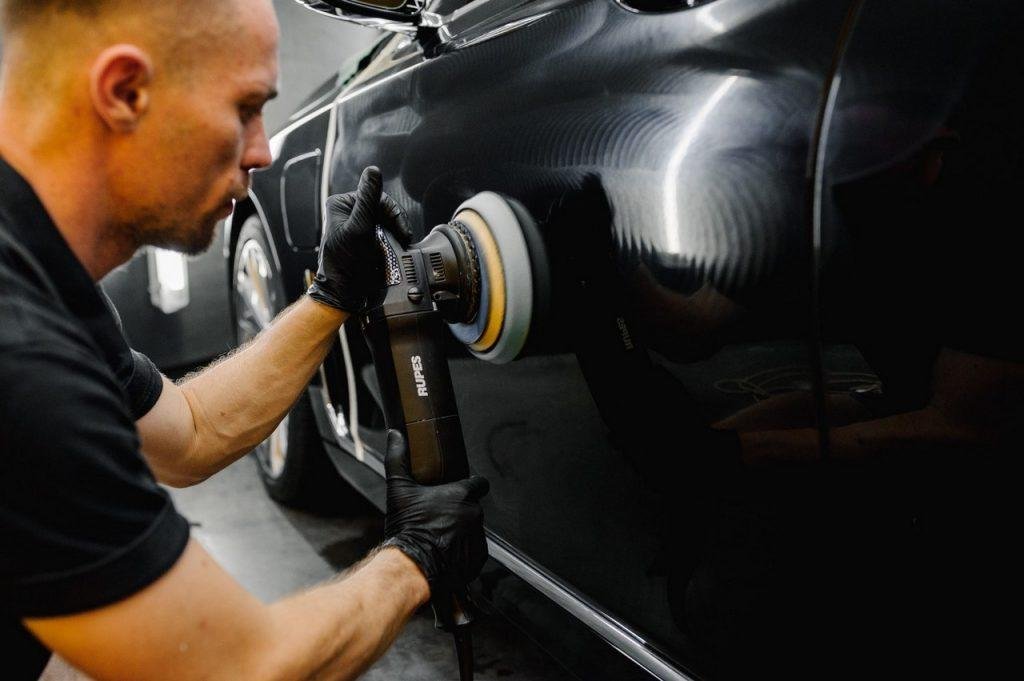
Polishing removes what spoils the look of a car without touching anything mechanical: fine scratches, oxidation, hazy clear coat, the swirl marks left by careless washing. Here is what actually happens to the paint, and why “polish it more often” is bad advice.

What polishing can and cannot do
The clear coat on a car body is a layer hundredths of a millimetre thick. Polishing removes the top part of it together with the defects sitting in that part. Which gives a simple rule: only what has not gone all the way through the clear coat can be removed.
Run a fingernail across the scratch. If it does not catch, polishing will most likely take it out. If it catches, the scratch has reached the base coat or the primer, and polishing will not fix it — it needs paint.
Why “every six months” is harmful advice
There is a finite amount of clear coat. Every abrasive polish uses up part of it, and it cannot be put back. A car polished to a schedule rather than to a need is left without its protective layer within a few years, and from then on any scratch goes straight to the base coat.
That is why paint polishing is done by condition, not by calendar. And before starting, the technician checks how much clear coat is left: a paint depth gauge shows this before anything is removed.

Abrasive and protective polishing are different jobs
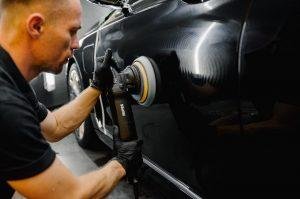
Abrasive polishing corrects defects: it removes a thin layer of clear coat and levels the surface. It is done when there is something to correct.
Protective polishing removes nothing — it adds a layer on top. Both give gloss, but the purpose differs: one repairs, the other preserves.
What happens at the studio
The sequence is the same for every car:
✔ washing and decontaminating the body — tar, insect residue, ingrained dirt
✔ inspection under directed light — defects are invisible in sunlight, which is one reason not to polish a car outdoors
✔ measuring clear coat thickness on every panel
✔ choosing compound and pad for that specific paint, working from coarse to finishing
✔ a finishing pass to an even gloss
What to do afterwards
Polishing restores the surface but does not protect it. To make the result last, a protective layer goes on top — a ceramic coating makes washing easier and slows down the return of fine scratches.

After that it all comes down to washing. The swirl marks that send a car to the polisher in the first place do not come from the road — they come from stiff brushes and dirty cloths.